AGN + Host Galaxy Fit - NGC 5728#
This notebook demonstrates a fit to the Seyfert galaxy NGC 5728 and its host galaxy, using multiwavelegnth photometry collected in the Brown et al. (2019) ‘AGNSEDATLAS’. We collected X-ray photometry for the X-ray point source associated with the nucleus from the Chandra Source Catalog, in four bands: ultrasoft, soft, medium, and hard. Again we note that the X-ray and multiwavelength photometry are not simultaneous.
The mukltiwavelength photometry cover the entire extend of the galaxy, not just the nucleus, meaning that they contain significant contributions from the host galaxy. As we’ll see, this dilution is significant enough that we can’t conclusively detect the AGN component in our mid-IR photometry, only the X-rays. We use our SED fit to answer a common question, especially at high redshift in cases of obscured AGN: if we assume an Eddington fraction, what is the resulting BH mass?
[46]:
import numpy as np
rng = np.random.default_rng()
import astropy.units as u
from astropy.table import Table
from astropy.io import ascii
import astropy.constants as const
import astropy.units as u
import matplotlib.pyplot as plt

from lightning import Lightning
from lightning.priors import UniformPrior, ConstantPrior, NormalPrior
plt.style.use('lightning.plots.style.lightning-serif')
Setup#
Fitting the X-ray model to fluxes is somewhat less complicated than fitting it to an instrumental spectrum, since we will (usually) have fewer bands, and we have a more homegenous dataset.
For this example, our X-ray photometry array already contains the fluxes converted to \(F_\nu\) in mJy, in addition to the fluxes in erg cm-2 s-1.
[2]:
phot = Table.read('../photometry/NGC5728_photometry.fits', hdu=1)
# arf = Table.read('../photometry/Mrk231_arf3.fits', hdu=1)
xray_phot = Table.read('../photometry/NGC5728_xray_photometry.fits', hdu=1)

print(xray_phot['ENERG_LO', 'ENERG_HI', 'FLUX', 'FLUX_UNC', 'FNU', 'FNU_UNC'])
ENERG_LO ENERG_HI         FLUX               FLUX_UNC                 FNU                  FNU_UNC
-------- -------- ------------------- ---------------------- ---------------------- ----------------------
     0.2      0.5 3.3193209249249e-15   1.19495553297295e-15 4.5758694416451106e-06 1.6473129989922206e-06
     0.5      1.2 3.0089184021393e-14 2.7653864684520005e-15 1.7776980912010367e-05 1.6338170695838985e-06
     1.2      2.0 1.2659455462062e-14 1.9651777694714992e-15  6.544412626887014e-06   1.01591527748952e-06
     2.0      7.0 7.6863430873421e-13 5.0862225098379986e-14  6.357632162758945e-05  4.206985226660801e-06
[79]:
filter_labels = phot['FILTER_LABELS']
fnu_obs = phot['FNU']
fnu_unc = phot['FNU_UNC']
lumdist = 29 # From NED
galactic_NH = 7.8 # e20 cm-2; from Colden.
[4]:
xray_filter_labels = xray_phot['FILTER_LABELS']
xray_fnu = xray_phot['FNU']
xray_fnu_unc = xray_phot['FNU_UNC']
The X-ray fluxes and filter labels are concatenated to their UV-IR counterparts.
[6]:
obs_full = np.zeros(len(xray_filter_labels) + len(filter_labels))
unc_full = np.zeros(len(xray_filter_labels) + len(filter_labels))
exp_full = np.zeros(len(xray_filter_labels) + len(filter_labels))

filter_labels_full = np.array(list(xray_filter_labels) + list(filter_labels))
xray_mask = np.array(['XRAY' in s for s in filter_labels_full])
obs_full[xray_mask] = xray_fnu
obs_full[~xray_mask] = fnu_obs
unc_full[xray_mask] = xray_fnu_unc
unc_full[~xray_mask] = fnu_unc
exp_full[xray_mask] = 1
[7]:
t = Table()
t['filter'] = filter_labels_full
t['flux'] = obs_full
t['unc'] = unc_full

ascii.write(t, format='fixed_width_two_line')
          filter                   flux                    unc
---------------- ---------------------- ----------------------
XRAY_0.2_0.5_keV 4.5758694416451106e-06 1.6473129989922206e-06
XRAY_0.5_1.2_keV 1.7776980912010367e-05 1.6338170695838985e-06
XRAY_1.2_2.0_keV  6.544412626887014e-06   1.01591527748952e-06
XRAY_2.0_7.0_keV  6.357632162758945e-05  4.206985226660801e-06
       GALEX_FUV                   0.52   0.026000000000000002
       GALEX_NUV                   1.16   0.057999999999999996
       UVOT_UVW2                   0.82                  0.041
       UVOT_UVM2                   0.88   0.044000000000000004
       UVOT_UVW1                   1.35                 0.0675
          UVOT_U                   3.64    0.18200000000000002
          UVOT_B                   9.43    0.47150000000000003
          UVOT_V                   18.4     0.9199999999999999
  Pan-STARRS_gp1                   17.2                   0.86
  Pan-STARRS_rp1                   31.5     1.5750000000000002
  Pan-STARRS_ip1                   42.0                    2.1
  Pan-STARRS_zp1                   53.5     2.6750000000000003
  Pan-STARRS_yp1                   66.4     3.3200000000000003
         2MASS_J                   85.3                   8.53
         2MASS_H                  109.0                   10.9
        2MASS_Ks                   94.8                   9.48
         WISE_W1                   51.3                  3.591
         WISE_W2                   38.6     2.7020000000000004
         WISE_W3                  211.0     14.770000000000001
         WISE_W4                  654.0                  45.78
        MIPS_CH1                  685.0                  34.25
       PACS_blue                 8130.0                  406.5
      PACS_green                 9541.0                 477.05
        PACS_red                 8618.0     430.90000000000003
       SPIRE_250                 3369.0     505.34999999999997
       SPIRE_350                 1390.0                  208.5
       SPIRE_500                  528.0                   79.2
The galaxy is 4-5 orders of magnitude fainter in the X-rays than in the UV-optical (in terms of \(F_\nu\)).
We construct our X-ray wavelength grid to cover the ultrasoft 0.2-0.5 keV band all the way to the hard 2-7 keV band (even though it’s probably not helpful to include the ultrasoft band, as we’ll see).
[80]:
hc_um = (const.c * const.h).to(u.micron * u.keV).value
lam_02 = hc_um / 0.2
lam_70 = hc_um / 7.0
xray_wave_grid = np.logspace(np.log10(lam_70), np.log10(lam_02), 200)
Our model specification uses the default 5 age bin SFH, the simple Calzetti model (although we have sufficient data quality in the UV and IR to use a more complex model), the QSOSED model, and the power law stellar population X-ray model. Since we’re using point source photometry for the nucleus, the X-ray stellar population model will likely overpredict the contribution of the stellar population to the X-rays. We’ll trying fitting without it later.
[28]:
lgh = Lightning(filter_labels_full,
                lum_dist=lumdist,
                flux_obs=obs_full,
                flux_obs_unc=unc_full,
                SFH_type='Piecewise-Constant',
                atten_type='Calzetti',
                dust_emission=True,
                agn_emission=True,
                agn_polar_dust=True,
                xray_mode='flux',
                xray_stellar_emission='Stellar-Plaw',
                xray_agn_emission='QSOSED',
                xray_absorption='tbabs',
                xray_wave_grid=xray_wave_grid,
                xray_arf={'ENERG_LO':[0,1],'ENERG_HI':[1,2], 'SPECRESP':[1,1]},
                xray_exposure=exp_full,
                galactic_NH=galactic_NH,
                model_unc=0.10,
                print_setup_time=True)
0.027 s elapsed in _get_filters
0.000 s elapsed in _get_wave_obs
0.550 s elapsed in stellar model setup
0.000 s elapsed in dust attenuation model setup
0.155 s elapsed in dust emission model setup
0.028 s elapsed in agn emission model setup
0.047 s elapsed in X-ray model setup
0.806 s elapsed total
/Users/eqm5663/Research/code/plightning/lightning/get_filters.py:138: RuntimeWarning: invalid value encountered in divide
  transm_norm_interp = transm_interp / trapz(transm_interp, wave_grid)
[57]:
lgh.print_params(verbose=True)
============================
Piecewise-Constant
============================
Parameter  Lo  Hi              Description
--------- --- --- ------------------------
    psi_1 0.0 inf SFR in stellar age bin 1
    psi_2 0.0 inf SFR in stellar age bin 2
    psi_3 0.0 inf SFR in stellar age bin 3
    psi_4 0.0 inf SFR in stellar age bin 4
    psi_5 0.0 inf SFR in stellar age bin 5

============================
Pegase-Stellar
============================
Parameter    Lo  Hi                                      Description
--------- ----- --- ------------------------------------------------
     Zmet 0.001 0.1 Metallicity (mass fraction, where solar = 0.020)

============================
Calzetti
============================
     Parameter  Lo  Hi                      Description
-------------- --- --- --------------------------------
calz_tauV_diff 0.0 inf Optical depth of the diffuse ISM

============================
DL07-Dust
============================
      Parameter     Lo       Hi                                                             Description
--------------- ------ -------- -----------------------------------------------------------------------
dl07_dust_alpha  -10.0      4.0                  Radiation field intensity distribution power law index
dl07_dust_U_min    0.1     25.0                                       Radiation field minimum intensity
dl07_dust_U_max 1000.0 300000.0                                       Radiation field maximum intensity
dl07_dust_gamma    0.0      1.0 Fraction of dust mass exposed to radiation field intensity distribution
dl07_dust_q_PAH 0.0047   0.0458                            Fraction of dust mass composed of PAH grains

============================
SKIRTOR-AGN
============================
        Parameter Lo Hi                                       Description
----------------- -- -- -------------------------------------------------
SKIRTOR_log_L_AGN  6 15    Integrated luminosity of the model in log Lsun
 SKIRTOR_cosi_AGN  0  1    Cosine of the inclination to the line of sight
   SKIRTOR_tau_97  3 11 Edge-on optical depth of the torus at 9.7 microns
  polar_dust_tauV  0  3 V-band optical depth of the polar dust extinction

============================
Stellar-Plaw
============================
Parameter   Lo  Hi  Description
--------- ---- --- ------------
 PhoIndex -2.0 9.0 Photon index

============================
QSOSED
============================
 Parameter   Lo   Hi                               Description
---------- ---- ---- -----------------------------------------
log_M_SMBH  5.0 10.0 log10 of the supermassive black hole mass
  log_mdot -1.5  0.3              log10 of the Eddington ratio

============================
tbabs
============================
Parameter  Lo       Hi             Description
--------- --- -------- -----------------------
       NH 0.0 100000.0 Hydrogen column density

Total parameters: 20
Rather than assuming a single, constant value of the Eddington ratio, we’ll assume a normal prior centered on -1.0, with a 0.3 dex standard deviation. This uncertainty will thus be propagated to our estimate of the BH mass.
[74]:
priors = [UniformPrior([0, 1e1]), # SFH
          UniformPrior([0, 1e1]),
          UniformPrior([0, 1e1]),
          UniformPrior([0, 1e1]),
          UniformPrior([0, 1e1]),
          ConstantPrior([0.020]), # Metallicity
          UniformPrior([0, 3]), # tauV
          ConstantPrior([2]), # alpha
          # ConstantPrior([1]), # Umin
          UniformPrior([0.1, 25]), # Umin
          ConstantPrior([3e5]), # Umax
          UniformPrior([0,1]), # Gamma
          UniformPrior([0.0047, 0.0458]), #qPAH
          UniformPrior([10,13]), # log L_AGN
          UniformPrior([0.0, 0.5]), # cos i - Limited to Type-2 views.
          UniformPrior([3,11]), # tau 9.7
          UniformPrior([0,1]), # polar dust tauV
          ConstantPrior([1.8]), # stellar pop. pho. index
          # UniformPrior([1.0, 2.5]), # AGN pho. index
          # UniformPrior([-1.3, 1.3]), # log deviation from Lusso + Risaliti 2017
          UniformPrior([5.0, 9.0]), # log BH mass
          # UniformPrior([-1.5, 0.0]), # log Eddington
          NormalPrior([-1.0, 0.3]), # log Eddington
          UniformPrior([1, 1e3]) # NH
          ]

Nwalkers = 64

p0s = [pr.sample(Nwalkers) for pr in priors]
p0 = np.stack(p0s, axis=-1)

p0[p0[:,-2] < -1.5, -2] = -1.5
p0[p0[:,-2] > 0.3, -2] = 0.3

Nsteps = 40000
const_dim = np.array([False, False, False, False, False,
                      True,
                      False,
                      True, False, True, False, False,
                      True, False, False, False,
                      True,
                      False, False,
                      False
                      ])

# print(p0[0,:])
[75]:
mcmc = lgh.fit(p0,
               method='emcee',
               Nwalkers=Nwalkers,
               Nsteps=Nsteps,
               priors=priors,
               const_dim=const_dim)
/Users/eqm5663/Research/code/plightning/lightning/stellar/pegase.py:449: RuntimeWarning: divide by zero encountered in log10
  finterp = interp1d(self.Zmet, np.log10(self.Lnu_obs), axis=1)
/Users/eqm5663/miniconda3_arm64/envs/ciao-4.16/lib/python3.11/site-packages/scipy/interpolate/_interpolate.py:701: RuntimeWarning: invalid value encountered in subtract
  slope = (y_hi - y_lo) / (x_hi - x_lo)[:, None]
100%|███████████████████████████████████████████████████████████████████████████████████████████████████████████| 40000/40000 [23:35<00:00, 28.26it/s]
[76]:
print('MCMC mean acceptance fraction: %.3f' % (np.mean(mcmc.acceptance_fraction)))
chain, logprob_chain, t = lgh.get_mcmc_chains(mcmc,
                                              discard=3000,
                                              thin=500,
                                              Nsamples=500,
                                              const_dim=const_dim,
                                              const_vals=p0[0,const_dim])
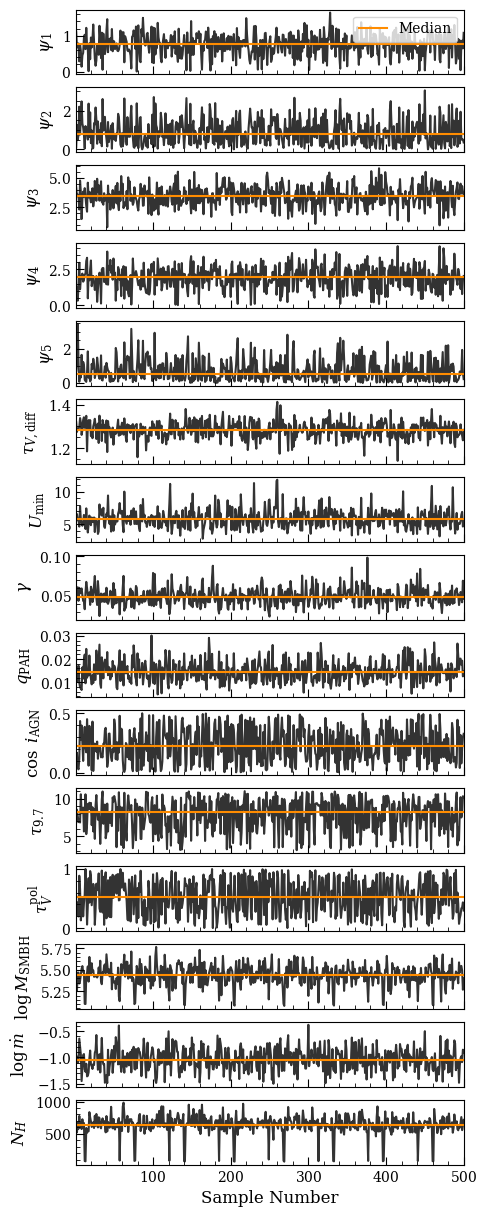
MCMC mean acceptance fraction: 0.214
[77]:
fig, axs = lgh.chain_plot(chain, color='black', alpha=0.8)
[78]:
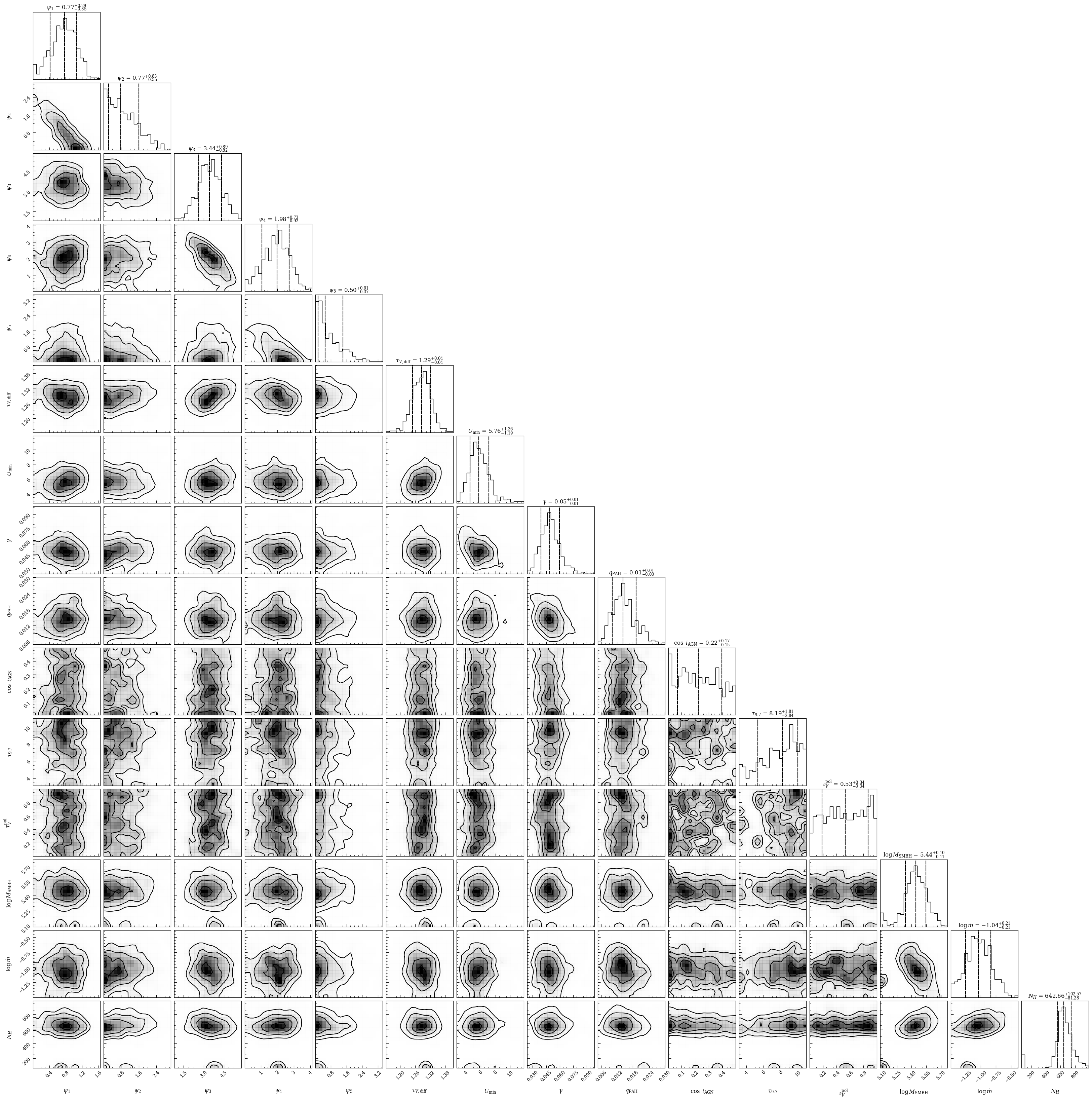
fig = lgh.corner_plot(chain,
                      quantiles=(0.16, 0.50, 0.84),
                      smooth=1,
                      levels=None,
                      show_titles=True)
[71]:
from lightning.plots import sed_plot_morebayesian, sed_plot_delchi_morebayesian, sfh_plot

fig5 = plt.figure(figsize=(12,6))
ax51 = fig5.add_axes([0.1, 0.26, 0.4, 0.64])
ax52 = fig5.add_axes([0.1, 0.1, 0.4, 0.15])
ax53 = fig5.add_axes([0.56, 0.1, 0.34, 0.8])

fig5, ax51 = sed_plot_morebayesian(lgh, chain, logprob_chain,
                                   plot_components=True,
                                   ax=ax51,
                                   legend_kwargs={'loc': 'upper left', 'frameon': False})
ax51.set_xticklabels([])
ax51.set_xlim(1e-4, 1200)
ax51.set_ylim(1e4,5e10)
fig5, ax52 = lgh.sed_plot_delchi(chain, logprob_chain, ax=ax52)
ax52.set_xlim(1e-4, 1200)
ax52.set_ylim(-10, 10)
fig5, ax53 = lgh.sfh_plot(chain, ax=ax53)
/Users/eqm5663/Research/code/plightning/lightning/stellar/pegase.py:449: RuntimeWarning: divide by zero encountered in log10
  finterp = interp1d(self.Zmet, np.log10(self.Lnu_obs), axis=1)
/Users/eqm5663/miniconda3_arm64/envs/ciao-4.16/lib/python3.11/site-packages/scipy/interpolate/_interpolate.py:701: RuntimeWarning: invalid value encountered in subtract
  slope = (y_hi - y_lo) / (x_hi - x_lo)[:, None]
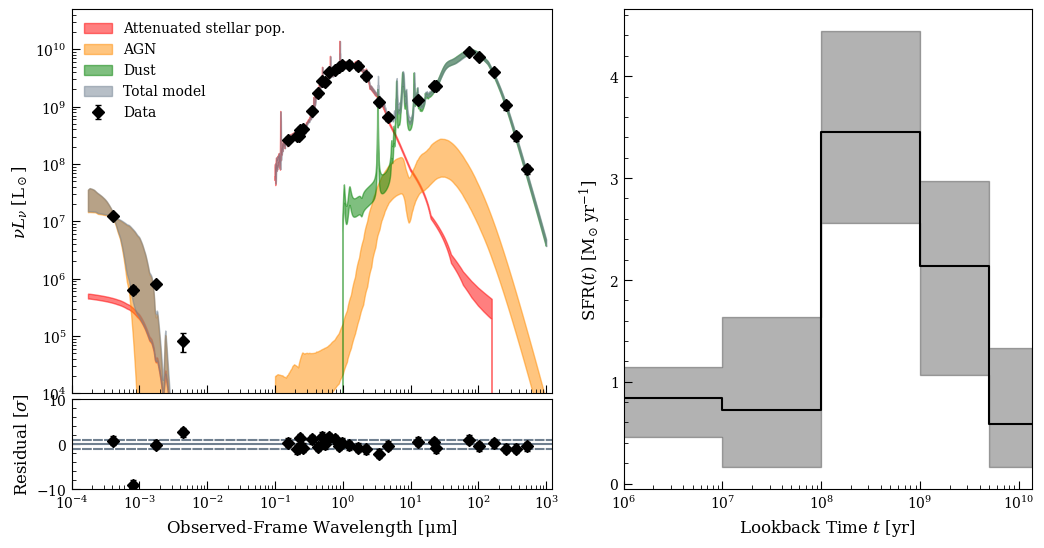
We can see that our model is predicting that a significant chunk of the X-rays come from the stellar population. We also do a very bad job at reproducing the Medium 1.2-2.0 keV flux; this may be due to underestimation of the uncertainties on this relatively narrow band.
Below, we show the posteriors on the stellar mass and BH mass.
[86]:
# We need these to determine the posterior on the total stellar mass;
# they are the ratio of the surving stellar mass to star formation
# rate as a function of age. They also depend on metallicity, so the
# stellar population models include a convenience function for extracting
# the appropriate coefficients for each metallicity.
mstar_coeff = lgh.stars.get_mstar_coeff(chain[:,5])
mstar_chain = np.sum(mstar_coeff * chain[:,:5], axis=1)

samples = np.stack([np.log10(mstar_chain), chain[:,-3]], axis=-1)
labels = [r'$\log M_{\star}$', r'$\log M_{\rm SMBH}$']

import corner
fig = corner.corner(samples, labels=labels, show_titles=True, quantiles=(0.16, 0.50, 0.84), smooth=1)
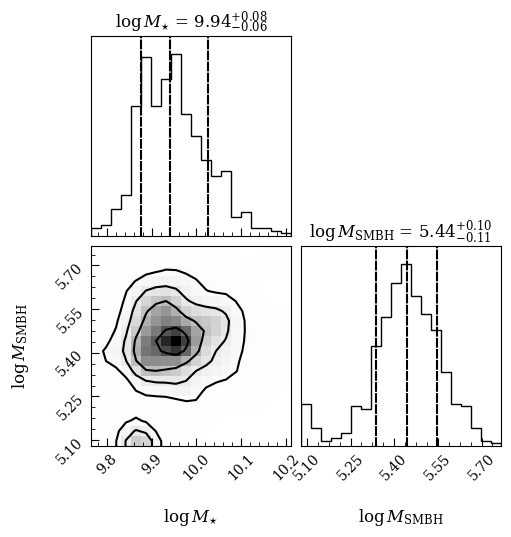
Our resulting BH mass is a few hundred thousand solar masses, relatively low considering the total stellar mass of the galaxy. We could however, assume an even lower Eddington ratio and find a larger mass.
Note that the stellar mass we’re looking at is the entire galaxy, not only the bulge, since we don’t have independent photometry for the bulge; we would need to assume a B/T ratio to convert \(M_{\star}\) into a bulge mass.
Below we re-fit the data, now assuming no contributions to the X-ray flux from the stellar population of the galaxy.
[88]:
lgh = Lightning(filter_labels_full,
                lum_dist=lumdist,
                flux_obs=obs_full,
                flux_obs_unc=unc_full,
                SFH_type='Piecewise-Constant',
                atten_type='Calzetti',
                dust_emission=True,
                agn_emission=True,
                agn_polar_dust=True,
                xray_mode='flux',
                xray_stellar_emission='None',
                xray_agn_emission='QSOSED',
                xray_absorption='tbabs',
                xray_wave_grid=xray_wave_grid,
                xray_arf={'ENERG_LO':[0,1],'ENERG_HI':[1,2], 'SPECRESP':[1,1]},
                xray_exposure=exp_full,
                galactic_NH=galactic_NH,
                model_unc=0.10,
                print_setup_time=True)
0.020 s elapsed in _get_filters
0.001 s elapsed in _get_wave_obs
0.547 s elapsed in stellar model setup
0.000 s elapsed in dust attenuation model setup
0.097 s elapsed in dust emission model setup
0.022 s elapsed in agn emission model setup
0.031 s elapsed in X-ray model setup
0.717 s elapsed total
/Users/eqm5663/Research/code/plightning/lightning/get_filters.py:138: RuntimeWarning: invalid value encountered in divide
  transm_norm_interp = transm_interp / trapz(transm_interp, wave_grid)
[89]:
lgh.print_params(verbose=True)
============================
Piecewise-Constant
============================
Parameter  Lo  Hi              Description
--------- --- --- ------------------------
    psi_1 0.0 inf SFR in stellar age bin 1
    psi_2 0.0 inf SFR in stellar age bin 2
    psi_3 0.0 inf SFR in stellar age bin 3
    psi_4 0.0 inf SFR in stellar age bin 4
    psi_5 0.0 inf SFR in stellar age bin 5

============================
Pegase-Stellar
============================
Parameter    Lo  Hi                                      Description
--------- ----- --- ------------------------------------------------
     Zmet 0.001 0.1 Metallicity (mass fraction, where solar = 0.020)

============================
Calzetti
============================
     Parameter  Lo  Hi                      Description
-------------- --- --- --------------------------------
calz_tauV_diff 0.0 inf Optical depth of the diffuse ISM

============================
DL07-Dust
============================
      Parameter     Lo       Hi                                                             Description
--------------- ------ -------- -----------------------------------------------------------------------
dl07_dust_alpha  -10.0      4.0                  Radiation field intensity distribution power law index
dl07_dust_U_min    0.1     25.0                                       Radiation field minimum intensity
dl07_dust_U_max 1000.0 300000.0                                       Radiation field maximum intensity
dl07_dust_gamma    0.0      1.0 Fraction of dust mass exposed to radiation field intensity distribution
dl07_dust_q_PAH 0.0047   0.0458                            Fraction of dust mass composed of PAH grains

============================
SKIRTOR-AGN
============================
        Parameter Lo Hi                                       Description
----------------- -- -- -------------------------------------------------
SKIRTOR_log_L_AGN  6 15    Integrated luminosity of the model in log Lsun
 SKIRTOR_cosi_AGN  0  1    Cosine of the inclination to the line of sight
   SKIRTOR_tau_97  3 11 Edge-on optical depth of the torus at 9.7 microns
  polar_dust_tauV  0  3 V-band optical depth of the polar dust extinction

============================
QSOSED
============================
 Parameter   Lo   Hi                               Description
---------- ---- ---- -----------------------------------------
log_M_SMBH  5.0 10.0 log10 of the supermassive black hole mass
  log_mdot -1.5  0.3              log10 of the Eddington ratio

============================
tbabs
============================
Parameter  Lo       Hi             Description
--------- --- -------- -----------------------
       NH 0.0 100000.0 Hydrogen column density

Total parameters: 19
[90]:
priors = [UniformPrior([0, 1e1]), # SFH
          UniformPrior([0, 1e1]),
          UniformPrior([0, 1e1]),
          UniformPrior([0, 1e1]),
          UniformPrior([0, 1e1]),
          ConstantPrior([0.020]), # Metallicity
          UniformPrior([0, 3]), # tauV
          ConstantPrior([2]), # alpha
          # ConstantPrior([1]), # Umin
          UniformPrior([0.1, 25]), # Umin
          ConstantPrior([3e5]), # Umax
          UniformPrior([0,1]), # Gamma
          UniformPrior([0.0047, 0.0458]), #qPAH
          UniformPrior([10,13]), # log L_AGN
          UniformPrior([0.0, 0.5]), # cos i - Limited to Type-2 views.
          UniformPrior([3,11]), # tau 9.7
          UniformPrior([0,1]), # polar dust tauV
          # UniformPrior([1.0, 2.5]), # AGN pho. index
          # UniformPrior([-1.3, 1.3]), # log deviation from Lusso + Risaliti 2017
          UniformPrior([5.0, 9.0]), # log BH mass
          # UniformPrior([-1.5, 0.0]), # log Eddington
          NormalPrior([-1.0, 0.3]), # log Eddington
          UniformPrior([1, 1e3]) # NH
          ]

Nwalkers = 64

p0s = [pr.sample(Nwalkers) for pr in priors]
p0 = np.stack(p0s, axis=-1)

p0[p0[:,-2] < -1.5, -2] = -1.5
p0[p0[:,-2] > 0.3, -2] = 0.3

Nsteps = 40000
const_dim = np.array([False, False, False, False, False,
                      True,
                      False,
                      True, False, True, False, False,
                      True, False, False, False,
                      False, False,
                      False
                      ])

# print(p0[0,:])
[91]:
mcmc = lgh.fit(p0,
               method='emcee',
               Nwalkers=Nwalkers,
               Nsteps=Nsteps,
               priors=priors,
               const_dim=const_dim)
/Users/eqm5663/Research/code/plightning/lightning/stellar/pegase.py:449: RuntimeWarning: divide by zero encountered in log10
  finterp = interp1d(self.Zmet, np.log10(self.Lnu_obs), axis=1)
/Users/eqm5663/miniconda3_arm64/envs/ciao-4.16/lib/python3.11/site-packages/scipy/interpolate/_interpolate.py:701: RuntimeWarning: invalid value encountered in subtract
  slope = (y_hi - y_lo) / (x_hi - x_lo)[:, None]
100%|███████████████████████████████████████████████████████████████████████████████████████████████████████████| 40000/40000 [19:29<00:00, 34.19it/s]
[92]:
print('MCMC mean acceptance fraction: %.3f' % (np.mean(mcmc.acceptance_fraction)))
chain, logprob_chain, t = lgh.get_mcmc_chains(mcmc,
                                              discard=3000,
                                              thin=500,
                                              Nsamples=500,
                                              const_dim=const_dim,
                                              const_vals=p0[0,const_dim])
MCMC mean acceptance fraction: 0.219
[93]:
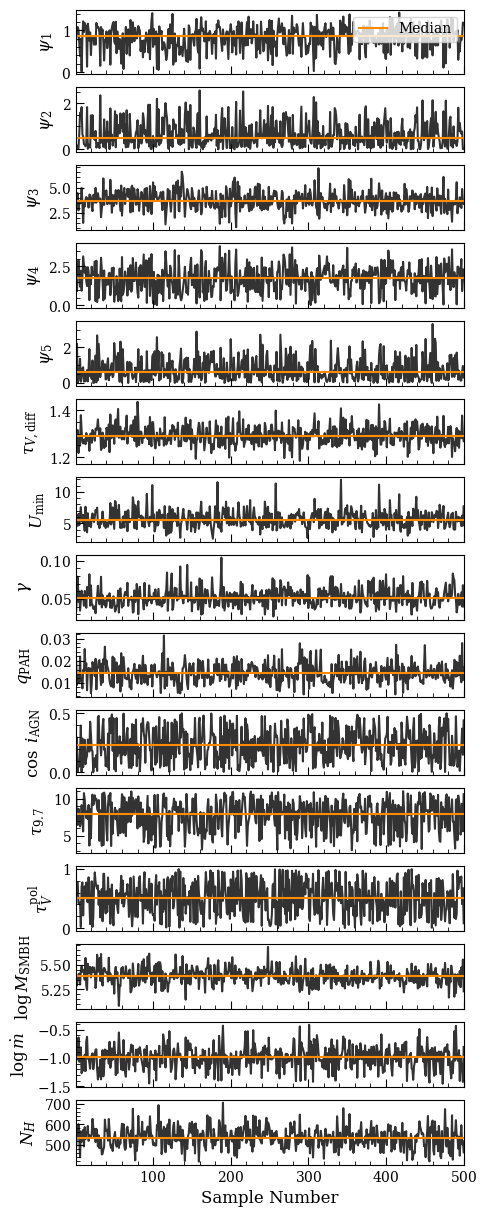
fig, axs = lgh.chain_plot(chain, color='black', alpha=0.8)
[94]:
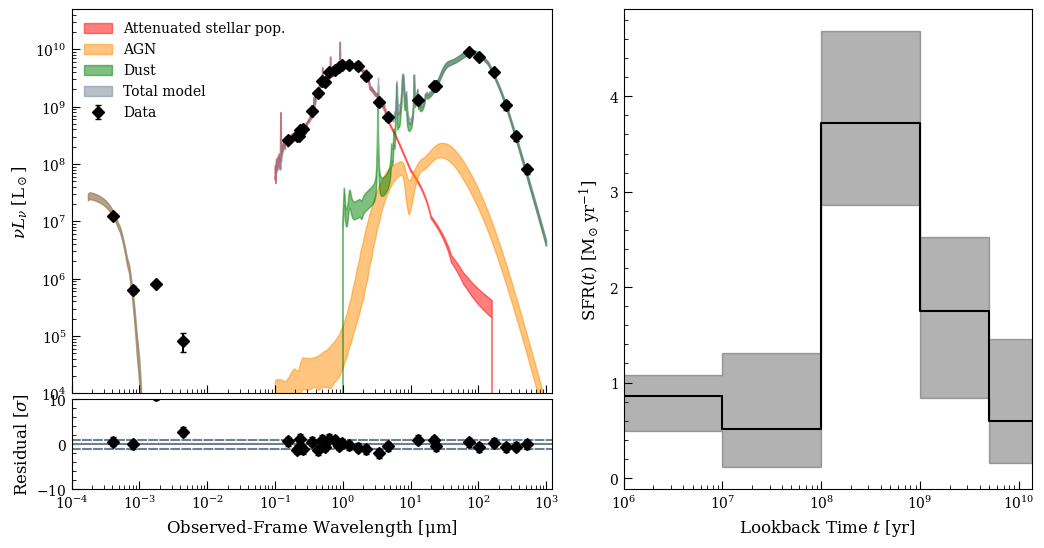
from lightning.plots import sed_plot_morebayesian, sed_plot_delchi_morebayesian, sfh_plot

fig5 = plt.figure(figsize=(12,6))
ax51 = fig5.add_axes([0.1, 0.26, 0.4, 0.64])
ax52 = fig5.add_axes([0.1, 0.1, 0.4, 0.15])
ax53 = fig5.add_axes([0.56, 0.1, 0.34, 0.8])

fig5, ax51 = sed_plot_morebayesian(lgh, chain, logprob_chain,
                                   plot_components=True,
                                   ax=ax51,
                                   legend_kwargs={'loc': 'upper left', 'frameon': False})
ax51.set_xticklabels([])
ax51.set_xlim(1e-4, 1200)
ax51.set_ylim(1e4,5e10)
fig5, ax52 = lgh.sed_plot_delchi(chain, logprob_chain, ax=ax52)
ax52.set_xlim(1e-4, 1200)
ax52.set_ylim(-10, 10)
fig5, ax53 = lgh.sfh_plot(chain, ax=ax53)
/Users/eqm5663/Research/code/plightning/lightning/stellar/pegase.py:449: RuntimeWarning: divide by zero encountered in log10
  finterp = interp1d(self.Zmet, np.log10(self.Lnu_obs), axis=1)
/Users/eqm5663/miniconda3_arm64/envs/ciao-4.16/lib/python3.11/site-packages/scipy/interpolate/_interpolate.py:701: RuntimeWarning: invalid value encountered in subtract
  slope = (y_hi - y_lo) / (x_hi - x_lo)[:, None]
/Users/eqm5663/Research/code/plightning/lightning/stellar/pegase.py:449: RuntimeWarning: divide by zero encountered in log10
  finterp = interp1d(self.Zmet, np.log10(self.Lnu_obs), axis=1)
/Users/eqm5663/miniconda3_arm64/envs/ciao-4.16/lib/python3.11/site-packages/scipy/interpolate/_interpolate.py:701: RuntimeWarning: invalid value encountered in subtract
  slope = (y_hi - y_lo) / (x_hi - x_lo)[:, None]
[95]:
mstar_coeff = lgh.stars.get_mstar_coeff(chain[:,5])
mstar_chain = np.sum(mstar_coeff * chain[:,:5], axis=1)

samples = np.stack([np.log10(mstar_chain), chain[:,-3]], axis=-1)
labels = [r'$\log M_{\star}$', r'$\log M_{\rm SMBH}$']

import corner
fig = corner.corner(samples, labels=labels, show_titles=True, quantiles=(0.16, 0.50, 0.84), smooth=1)
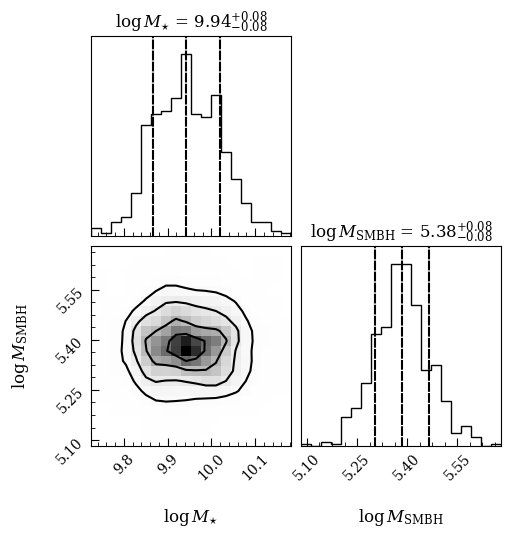
We find much the same result as when we included the stellar population model in the X-rays, only now we successfully fit the M and H bands rather than the S and H bands. As a next step, we might try to match the SNR of the X-ray data to the UV-IR data to get a better fit in the X-rays.